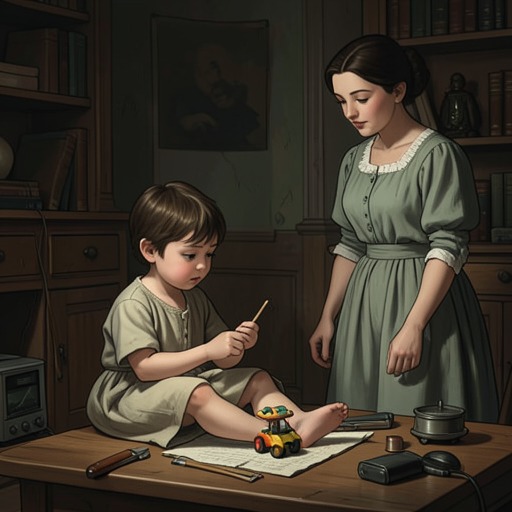
Anna Fyodorovna Krassotkina
The Brothers KaramazovAnna Fyodorovna Krassotkina, known as Madame Krassotkin, is Kolya Krassotkin’s mother and the widowed mistress of a tidy house near the market-place and Plotnikov’s shop. For fourteen years she has devoted herself to her son, the cherished center of her life; when he undertakes a dangerous railway exploit, her terror exposes the strain beneath that devotion, and his return to her arms briefly breaks through his pose of manly composure.
Identity and Background
Anna lives in a small, exceptionally clean house close to Plotnikov’s shop, not far from the market-place. The house is hers, and she maintains it on her private means. Its neatness and her respectable seclusion establish a carefully ordered domestic life, set apart from the public world in which her son’s exploits and reputation take shape.
She is the widow of a former provincial secretary, dead for fourteen years. At his death she was about eighteen, had been married for only a year, and had just given birth to Kolya. By the time the narrative describes her again, she is thirty-two and still good-looking. Her adult identity has thus been formed almost entirely within a long period of widowhood and motherhood: she was barely out of adolescence when she became solely responsible for raising an infant son.
The account describes her as soft-natured but fairly cheerful. That temperament does not mean her life with Kolya has been easy. Though she loves him passionately, his fourteen years have brought her much more suffering than happiness. The contrast makes her character legible through the particular burdens of care: affection is not a quiet background quality, but a daily attachment repeatedly tested by the boy’s actions.
Motherhood and Domestic Life
From the day her husband died, Anna devoted herself heart and soul to bringing up Kolya, whom she regarded as her precious treasure. The phrase captures both the intensity and the focus of her maternal life. Her husband’s death left her a very young widow with a newborn; the narrative presents raising the child as the work around which her subsequent years have been organized.
That devotion is not depicted as a simple story of a grateful child and a fulfilled parent. Kolya has caused her far more suffering than happiness, even as she continues to love him passionately. The tension between those facts gives their bond its shape: she cherishes him without being spared the anxiety and distress created by his independence and exploits.
Anna’s house and her seclusion provide the setting for this close family relationship, but Kolya’s life repeatedly carries its consequences beyond the home. His conduct can turn her private worry into acute alarm, while her responses reveal how completely his safety matters to her. The narrative does not supply a broader account of her social or political life; it emphasizes the intimate, enduring labor of raising her son.
The Railway Exploit and Its Aftermath
Kolya’s railway exploit marks a sharp crisis in their relationship. When Anna hears what her son has done, she is so horrified that she almost goes out of her mind. Her response makes the risk more than a youthful adventure: what Kolya can treat as a demonstration of nerve becomes, for his mother, a threat to the son whose upbringing has occupied fourteen years of her life.
At her instance, Kolya kneels before a holy image and swears by his father’s memory. The oath brings the dead father directly into the scene of maternal discipline: Anna asks her son to answer for his conduct through a solemn appeal to the memory of the man who died when Kolya was still an infant. Kolya, who has presented himself as manly, bursts into tears like a six-year-old boy.
For the rest of that day mother and son repeatedly rush into each other’s arms, sobbing. Their response to the danger is physical and mutual, not merely a reprimand followed by an apology. The embrace temporarily undoes Kolya’s practiced self-command and gives Anna’s fear an answering tenderness. The scene shows how quickly the supposedly grown-up performance of the boy yields when his mother’s terror and the memory of his father enter the room.
The change in Kolya does not amount to a permanent conversion. The following day he wakes as unfeeling as before, but he has become more silent, modest, stern, and thoughtful. The narrative therefore distinguishes the immediate emotional release from its longer effect: the tears pass, yet the experience leaves him quieter and more reflective. For Anna, the railway episode demonstrates both the limits and the force of her influence—she cannot erase her son’s independence, but she can bring him back, briefly and unmistakably, into the intimacy of childhood.
Character and Narrative Significance
Anna is presented chiefly through the circumstances and effects of her motherhood: a young widow, a small clean house, a life of respectable seclusion, and an all-consuming devotion to Kolya. The railway episode concentrates those elements into a single reversal. The boy’s daring, which might sustain his reputation among others, nearly destroys his mother with horror; before the holy image, his public pose collapses into tears, and the two cling to one another.
The difference between the scene’s intense embrace and Kolya’s return to apparent unfeelingness the next morning keeps the relationship from resolving into a sentimental reconciliation. Anna’s love is enduring, but it does not make her son reliably obedient or permanently softened. Instead, the incident reveals a bond in which care, fear, independence, and renewed closeness coexist. Her significance lies in making visible the private human cost of Kolya’s exploits and in showing the maternal attachment that his confident exterior cannot simply dismiss.